
AIbox
Nuxia AIbox is a versatile private AI platform equipped with both the infrastructure and essential components required to swiftly develop and deploy any generative AI application.
Nuxia AIbox is fully based on open source components that shape its backbone and functionality, handling everything from data storage and AI model orchestration to workflow automation, monitoring, and secure deployment environments.
Features
Open Source
Based on open source software, from the operating system to the user interface.
Fully Programmable
Focused on easy application creation (no code, or very low code volume) as well as fully programmable using popular programming frameworks (such as LangChain or LlamaIndex).
Can work offline
The platform can work in environments connected to the internet, as well as in those environments that, due to specific security requirements, must be totally disconnected from the internet.
Local and cloud-compatible
It works both with local LLM(s) and with other SaaS APIs such as OpenAI (requiring, in this case, an Internet connection).
Scalable with CPU/GPU
It can work with any number of CPU(s) and/or GPU(s), scaling both vertically and horizontally.
Easy, fast deployment
It is easy and fast to deploy, running on any machine or cluster where there are CPU(s)/GPU(s) with Linux operating system and Docker container manager.
Standalone or easily integrable
It can run in standalone mode and/or be easily integrated into any AI/ML/RPA process.
Full observability engine
It has a complete observability engine (logs, metrics, traces, dashboards).
Supports RAG & LLMs
Supports RAG, LLM finetuning, agent configuration and component scheduling, for virtually limitless functionality expansion.
Flexible hardware & deployment
It’s shipped with hardware in three configurations: appliance, rackable and embedded (soon). It can also be deployed as a standalone software appliance, either in on-premises servers or in public cloud instances.
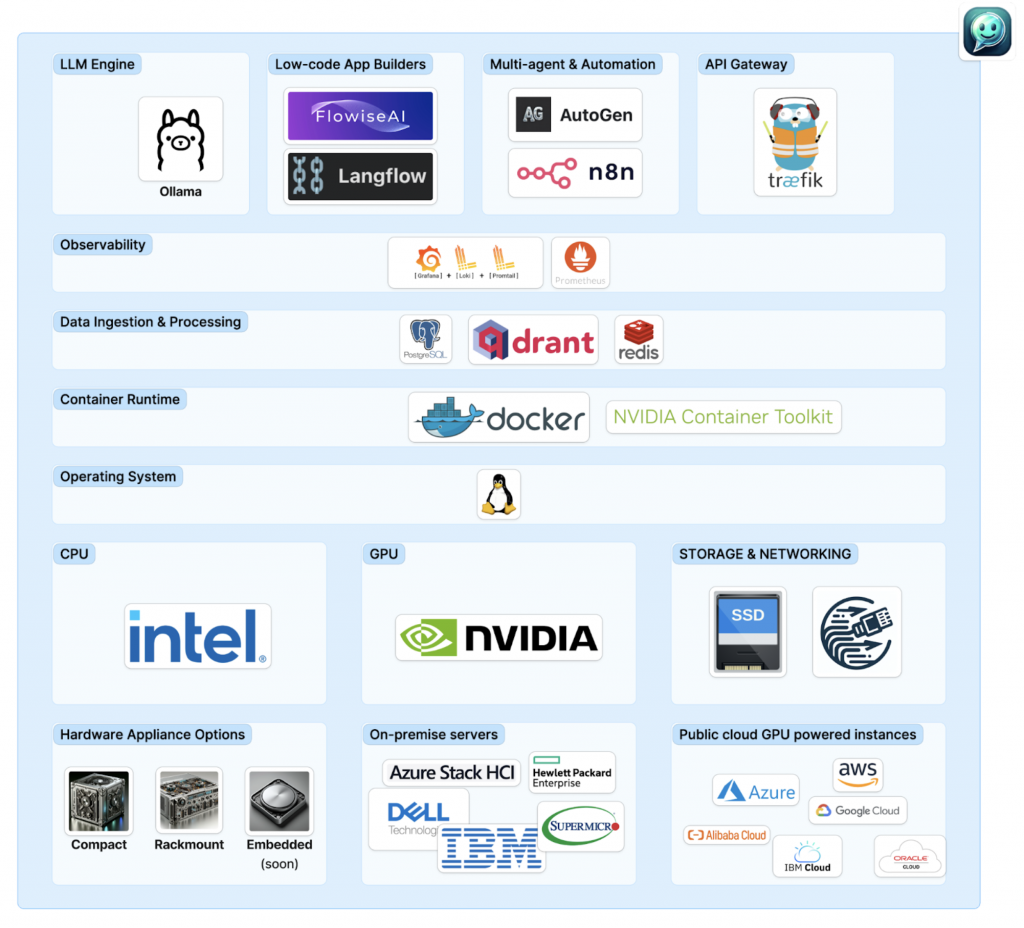
These components are:
AI Model Management and Orchestration
Ollama
Manages large language models, providing infrastructure for deploying and optimizing model performance.
FlowiseAI
Visual AI workflow builder, enabling orchestration of models and AI processes.
Langflow
Focused on language model-based AI workflows, providing a visual interface for designing NLP pipelines.
Autogen
Automates AI-driven generation tasks, often related to content creation or dynamic workflow execution.
Data Management and Search
Qdrant
Vector database for storing and querying high-dimensional data, useful for semantic search and AI model retrieval.
Redis
In-memory database for fast data access, often used as a cache or for message queuing in AI pipelines.
PostgreSQL
Relational database for structured data storage, used for persisting configuration, logs, or structured data required by AI applications.
Workflow Automation
n8n
Automates data pipelines, model deployment workflows, and task automation by connecting services and components visually.
Traffic Routing and Load Balancing
Traefik
Provides reverse proxying, load balancing, and traffic management, important for routing API requests and managing access to various AI services.
Monitoring, Logging, and Observability
Prometheus
Monitoring and alerting tool, collecting and analyzing metrics from various components, useful for system health and performance tracking.
Promtail
Log collection agent that ships logs to Loki, helping to centralize logging across distributed AI services.
Loki
Log aggregation for collecting and centralizing logs, which is useful for debugging and monitoring AI systems.
Grafana
Visualization platform for metrics and logs, helping monitor AI performance and infrastructure.
Containerization and Deployment
Docker Engine
Containerization platform that allows packaging AI services and their dependencies into isolated containers for easy deployment.
NVIDIA Container Toolkit
Integrates NVIDIA GPUs into Docker containers, enabling hardware acceleration for AI model training and inferencing.
Security and Compliance
-
Linux Operating System (like Canonical Ubuntu/Ubuntu Pro)
Provides extended security, compliance, and premium support for the AI platform, ensuring a secure and reliable operating environment for AI workloads.
AI use cases for which this platform could be particularly effective
Multi-Agent AI-Based Applications
Use Case: Build and deploy applications where multiple AI agents collaborate to solve complex tasks, automate workflows, or simulate decision-making processes. Each agent can be designed to specialize in different areas, communicate with one another, and make decisions autonomously.
■ Ollama: Provides advanced language models that enable AI agents to understand and process natural language, allowing for human-like interactions and decision-making.
■ Qdrant: Acts as a shared knowledge base where agents can store and retrieve vectorized information, ensuring that agents can perform similarity searches and quickly access relevant data.
■ Redis: Used for inter-agent communication, caching shared states, and real-time message passing between agents.
■ FlowiseAI / Langflow: Orchestrates the interactions between multiple agents, setting up workflows that define how agents communicate, collaborate, and exchange data.
■ n8n: Automates workflows between different AI agents and external services, enabling multi-agent tasks to trigger various actions across systems.
■ Prometheus / Grafana: Monitor the performance and interaction of agents, ensuring that the multi-agent system runs smoothly and identifying any bottlenecks or inefficiencies in agent communication.
■ Autonomous Systems: Multiple AI agents can collaborate to manage complex systems such as smart cities, energy grids, or supply chain automation, where different agents handle specialized tasks like optimization, monitoring, and predictive maintenance.
■ Simulations and Decision-Making: AI agents can simulate human or organizational behaviors, making this suitable for applications in financial market simulations, urban planning, or military strategy.
■ Collaborative Robotics: In industrial settings, multiple AI-powered robots can work together to accomplish tasks, optimizing operations and responding to dynamic environments autonomously.
Natural Language Processing (NLP) and Generation
Use Case: Build AI models that understand, process, and generate human language.
■ Ollama: Fine-tuning and deployment of large language models (LLMs) like GPT for tasks such as text generation, summarization, translation, and question answering.
■ Langflow: Visual design of NLP workflows like chatbots or language comprehension systems.
■ FlowiseAI: Orchestrating multi-step NLP tasks such as sentiment analysis, named entity recognition (NER), and machine translation.
■ Autogen: Automating content creation, such as generating marketing copy, blog posts, or personalized customer responses.
Recommendation Systems and Similarity Search
Use Case: Implement recommendation engines and systems that rely on similarity between users, products, or content based on vector embeddings.
■ Qdrant: Store and query high-dimensional vector embeddings for product or content recommendations (e.g., personalized recommendations for users based on previous interactions).
■ Redis: Caching frequently queried data to speed up recommendations.
Automated Workflow and Decision-Making Pipelines
Use Case: Automate complex AI-driven decision-making workflows in business processes, supply chains, or data pipelines.
■ n8n: Automate repetitive tasks such as data extraction, transformation, and feeding into AI models. For example, using AI models to categorize incoming emails or auto-respond to customer queries.
■ FlowiseAI: Enable decision-making processes using AI models, where various tasks like prediction and categorization can be chained together.
Predictive Analytics and Forecasting
Use Case: Utilize AI for predicting outcomes and generating actionable insights based on historical data.
■ Ollama: Use predictive models for demand forecasting, stock market analysis, or predictive maintenance.
■ PostgreSQL: Store structured historical data that can be queried and fed into AI models for prediction.
■ Prometheus/Grafana: Monitor model performance and the accuracy of predictions over time.
Real-Time Monitoring and Anomaly Detection
Use Case: Create AI systems that monitor real-time data streams to detect anomalies, perform root cause analysis, or send alerts.
■ Grafana/Prometheus: Track system metrics and performance, using AI models to detect unusual patterns or system failures.
■ Loki/Promtail: Collect and analyze logs for detecting anomalies in application behavior, such as spikes in latency or error rates.
■ Redis: Cache real-time data streams for quick access during anomaly detection.
AI-Driven API Gateways and Traffic Management
Use Case: Deploy AI services as APIs for consumption by other applications and manage the traffic through advanced routing, load balancing, and service mesh architecture.
■ Traefik: Manage traffic to various AI services, balancing requests based on load or geographical location.
■ Docker: Containerize AI models, exposing them as scalable, maintainable APIs.
Multimodal AI Systems
Use Case: Create systems that process multiple types of inputs, such as text, images, and structured data, and provide a unified AI-driven output.
■ Ollama: Fine-tune models to handle multi-modal tasks (e.g., combining text analysis with image recognition).
■ FlowiseAI: Orchestrate workflows that require multi-modal input and output pipelines.
AI-powered DevOps Automation
Use Case: Leverage AI to automate and enhance DevOps workflows, such as CI/CD pipelines, monitoring, and alerting.
■ n8n: Automate DevOps tasks like continuous integration pipelines, deploying models, and managing system health checks.
■ Prometheus/Grafana: Integrate AI with DevOps monitoring tools to automatically detect performance bottlenecks and suggest optimizations.
AI for Edge and GPU-Accelerated Workloads
Use Case: Run AI models on GPU-accelerated environments for tasks requiring high computational power, such as training models on large datasets or performing inference in real time at the edge.
■ NVIDIA Container Toolkit: Enable AI models to utilize GPU resources within Docker containers, optimizing tasks like deep learning training and inferencing.
■ Linux Operating System: Provide the secure and stable environment necessary for running high-performance AI workloads, especially in enterprise settings.
AI-Driven Security and Compliance Solutions
Use Case: Build security-related AI solutions, such as intrusion detection systems, fraud detection, or automated compliance checks.
■ Ollama: Fine-tune AI models to detect suspicious activity based on patterns in large data sets.
■ Grafana/Loki: Visualize and aggregate logs, identifying abnormal behavior or security breaches.
■ Ubuntu Pro: Ensure compliance and security for running sensitive AI workloads with extended support and security updates.